SSC CGL 2026: Application Window Reopened Until June 25 – 12,256 Posts, What Changed and Why the Sectional Timing Matters
By C. Thiruvenkatam | Daily Hind News | 22 June 2026
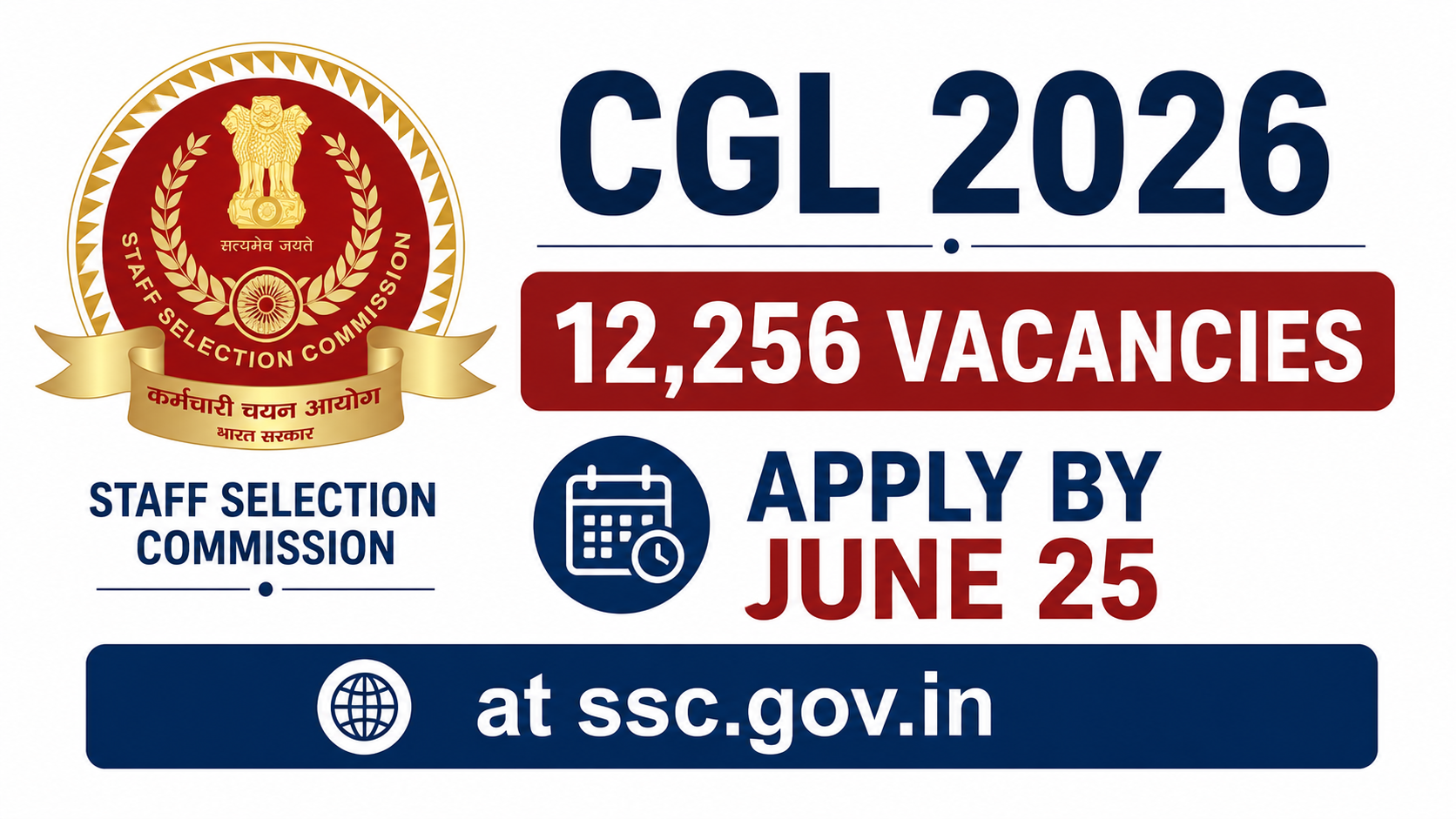
The Staff Selection Commission reopened the SSC CGL 2026 application window on June 23, following requests from candidates who missed the original June 22 deadline. The window stays open until June 25, 2026, at 11:00 PM. Fee payment has been extended to June 26. If you have been sitting on this application, there are literally 48 hours left.
28 lakh applications have already been submitted. That number frames what you are walking into: the most competitive graduate-level central government exam in the country, with 12,256 vacancies across dozens of posts in central ministries and departments.
One major change in this year’s cycle that most guides have not addressed properly: sectional timing has been introduced for the first time in SSC CGL Tier 1. Every section now has a hard 15-minute limit. Once time is up, the system moves you to the next section whether you are ready or not. This changes how the exam needs to be prepared for – and that change is explained in full below.
Official website: https://ssc.gov.in Direct application link: https://ssc.gov.in (login and select SSC CGL 2026 from the candidate dashboard)
1. All important dates at a glance
| Event | Date |
|---|---|
| Application window reopened | 23 June 2026 (11:00 PM) |
| Last date to apply | 25 June 2026 (11:00 PM) |
| Last date for fee payment | 26 June 2026 (11:00 PM) |
| Application correction window | 29 June to 1 July 2026 (11:00 PM) |
| Tier 1 Computer Based Examination | August to September 2026 (tentative) |
| Tier 2 Examination | December 2026 (tentative) |
2. Who is this reopening for – and is it too late to start now?
SSC reopened the window specifically for candidates who could not complete the process before June 22. The reopening is not a new recruitment cycle – all eligibility conditions, vacancy numbers, and recruitment rules remain unchanged. Anyone who qualifies for the original notification qualifies now.
28 lakh applications received by June 22 is not a deterrent to applying. SSC CGL consistently draws 30-40 lakh applications each cycle. The vacancies this year total 12,256, which works out to roughly 25-30 applicants per post before any elimination by stage. Tier 1 filters that significantly – typically 2-3 times the vacancies move to Tier 2.
For someone who is prepared and was going to apply anyway, the window reopening is a straightforward opportunity. For someone starting fresh: the exam is August-September, which is 8-10 weeks away. That is tight but workable for candidates who have a strong foundation. The decision depends on your current preparation level, not on whether the reopening was intended for you.
3. How to apply: OTR, live photo, and the steps that trip people up
Step 1: Complete One-Time Registration (OTR) if you have not done it before
OTR is mandatory for all first-time applicants on the new SSC portal. Go to https://ssc.gov.in, click on “New User? Register Now,” and complete the registration. You will need:
- Class 10 roll number, board name, and passing year
- Aadhaar card number (Aadhaar-based authentication is mandatory during OTR) or any other valid government-issued photo ID
- Active mobile number and email ID (all communications come here)
OTR is a one-time process. Once done, it is used across all future SSC examinations – you will not need to repeat it.
Step 2: Fill the application form
Log in to your candidate dashboard using the OTR credentials. Select SSC CGL 2026 from the available examinations. Fill in your personal details, educational qualifications, and category correctly. Check every field before moving forward – mistakes made here cost Rs 200 to fix after submission.
Step 3: Live photo capture during submission
SSC captures a live photograph during the application process – this is not an uploaded selfie. The system uses your device camera to take a real-time photo. Ensure your face is clearly visible: no spectacles, no caps, proper lighting. The photo taken here is used to verify identity throughout the recruitment process, including at the exam centre and during document verification. A bad live photo can cause issues later.
Step 4: Upload signature
Scan your handwritten signature and upload in JPG format, 1 KB to 12 KB. The signature should be on white paper in blue or black ink.
Step 5: Pay the application fee
Fee: Rs 100 for General, OBC, and EWS candidates Exempt: SC, ST, PwBD, Women, and Ex-Servicemen candidates
Payment modes: BHIM UPI, Net Banking, Visa/Mastercard/RuPay debit card, or SBI Challan.
The fee is non-refundable under any circumstance. SSC has no withdrawal scheme for CGL applications. Once paid, the amount is gone regardless of whether you appear for the exam or not.
Step 6: Submit and save the confirmation page
After submission, download and save the confirmation receipt. This is your proof of application and is needed if you raise any correction request or lodged a helpdesk query.
4. Vacancies and posts: what you are actually applying for
The 12,256 vacancies announced are tentative. SSC will compile final ministry-wise and department-wise vacancy data before Tier 1. The number may change – upward or downward – once all participating departments confirm their requirements.
The posts span two categories:
Group B (Gazetted and Non-Gazetted):
| Post | Pay Level | Basic Pay |
|---|---|---|
| Assistant Audit Officer (AAO) | 8 | Rs 47,600 |
| Assistant Accounts Officer | 8 | Rs 47,600 |
| Assistant Section Officer (ASO) – in MEA, Intelligence, various | 7 | Rs 44,900 |
| Inspector (Central Excise, Examiner, Preventive Officer) | 7 | Rs 44,900 |
| Sub Inspector (CBI, NIA) | 7 | Rs 44,900 |
| Statistical Investigator Grade II | 7 | Rs 44,900 |
Group C:
| Post | Pay Level | Basic Pay |
|---|---|---|
| Auditor (various) | 6 | Rs 35,400 |
| Accountant / Junior Accountant | 6 | Rs 35,400 |
| Senior Secretariat Assistant / Upper Division Clerk | 4 | Rs 25,500 |
| Tax Assistant (CBDT, CBIC) | 4 | Rs 25,500 |
Note on AAO: The Assistant Audit Officer post requires a CA/ICWA/MBA Finance/Economics qualification in addition to the basic graduation requirement. Check the notification PDF carefully before selecting this post preference.
Note on Sub Inspector (CBI): This post has a physical fitness requirement and carries field duties. The job profile is very different from a desk-based ASO role.
5. Eligibility: age, qualification, and the post-specific requirements
Educational qualification: A Bachelor’s degree from a recognised university or equivalent is the baseline for all posts. Certain posts require specific streams or professional qualifications as noted in the table above.
Age limit (as on 1 August 2026):
| Post category | Age range |
|---|---|
| Most Group B and Group C posts | 18 to 32 years |
| Some specific posts (refer notification) | 18 to 27 years |
| Statistical Investigator Grade II, JSO | 18 to 30 years |
Age relaxation:
| Category | Relaxation |
|---|---|
| SC/ST | 5 years |
| OBC (NCL) | 3 years |
| PwBD (General) | 10 years |
| PwBD (OBC) | 13 years |
| PwBD (SC/ST) | 15 years |
| Ex-Servicemen | As per government rules |
Nationality: Indian citizen. Some posts also allow subjects of Nepal, Bhutan, Tibetan refugees (settled before January 1, 1962), and persons of Indian origin from specific countries, subject to a certificate of eligibility issued by the Government of India.
There is no limit on the number of attempts for SSC CGL. A candidate can appear every year as long as they fall within the age limit.
6. The sectional timing change: what it means for your preparation
This is the most strategically significant change in SSC CGL 2026 that most guides understate.
Until the previous cycle, Tier 1 was a 60-minute paper with four sections and no restriction on how you distributed that time. A candidate strong in Quantitative Aptitude could spend 25 minutes there, blow through General Awareness in 8 minutes, and manage the remaining 27 across Reasoning and English. Weak sections were covered by strong ones.
That strategy no longer works.
SSC has introduced 15 minutes per section for Tier 1. When the 15-minute clock for one section expires, the system automatically advances to the next section. You cannot go back. Unattempted questions in the time-expired section are marked as not answered.
What this means in practice:
Every section now demands independent preparation. A candidate with strong Quantitative Aptitude but poor General Awareness cannot compensate. A candidate who memorises grammar rules but struggles with Reasoning has no way to offset that gap with extra time spent elsewhere.
The 15-minute window per section is also a precision test. Tier 1 has 25 questions per section. 15 minutes for 25 questions is 36 seconds per question – a pace that leaves no room for reading a question three times. Speed at each individual topic becomes as important as accuracy.
Revised preparation priorities:
- All four sections need roughly equal preparation depth. No skipping, no intentional neglect.
- Mock tests must now be practised section-by-section with 15-minute timers – not as full 60-minute papers where time reallocation is possible.
- General Awareness, the section that was previously left for the last few minutes, now needs dedicated preparation. 25 questions in 15 minutes requires prior knowledge, not last-minute guessing.
7. Exam pattern: Tier 1 and Tier 2 structure
Tier 1 (Computer Based Test):
| Section | Questions | Marks | Time |
|---|---|---|---|
| General Intelligence and Reasoning | 25 | 50 | 15 minutes |
| General Awareness | 25 | 50 | 15 minutes |
| Quantitative Aptitude | 25 | 50 | 15 minutes |
| English Language and Comprehension | 25 | 50 | 15 minutes |
| Total | 100 | 200 | 60 minutes |
Negative marking: 0.5 marks per wrong answer.
Tier 1 is a screening stage only. Tier 1 scores are not counted in the final merit list. Their purpose is to shortlist candidates for Tier 2.
Tier 2 (Computer Based Test):
Tier 2 is where the final merit is prepared. It has two sessions on the same day:
- Session 1: Mathematical Abilities, Reasoning and General Intelligence, English Language and Comprehension, General Awareness, and Computer Knowledge Test
- Session 2: Data Entry Speed Test (DEST) – qualifying in nature, required for specific posts
Tier 2 also has sectional timing. The negative marking rate is 1 mark per wrong answer in Paper 1, not 0.5 as in Tier 1.
Final selection: Tier 2 performance determines the merit list. Candidates qualifying both stages proceed to Document Verification and appointment.
8. The correction window: what you can fix, what it costs, and what you cannot change
After submitting and paying, SSC allows limited corrections through the correction window: June 29 to July 1, 2026 (up to 11:00 PM).
Cost:
- First correction: Rs 200
- Second correction: Rs 500
- Maximum corrections allowed: two
What can typically be corrected: Name spelling errors, date of birth, category, educational qualifications, exam centre preference. SSC specifies the permitted fields in the correction notice – not everything can be edited.
What cannot be corrected: Core identity documents once submitted are generally not editable. Details linked to Aadhaar authentication are also fixed after OTR.
One thing candidates frequently discover too late: if your name as entered does not match your Class 10 certificate exactly (middle names, initials handled differently, spelling variations), that creates a problem at Document Verification – not immediately. By the time you know, the correction window has long closed. Spend five minutes comparing the form with your Class 10 certificate before submitting.
Frequently asked questions
The application was already submitted before June 22. Do I need to do anything during the reopening?
No. If you applied and paid before June 22, your application is complete. The reopening is only for candidates who had not yet applied. Your correction window remains June 29 to July 1 as announced.
I applied during the original window but made an error in my application. Can I use the correction window?
Yes. The correction window applies to all submitted applications – those submitted in the original window and those submitted during the reopening. Both categories can use the June 29 to July 1 window.
What is the difference between OTR Registration ID and the CGL Application Number?
OTR Registration ID is your permanent profile on the SSC portal – it is used to apply for all future SSC exams. The CGL Application Number is generated specifically when you apply for CGL 2026. Both are needed for different purposes – keep both safe.
Can I select all posts in the preference list?
Yes, you can indicate multiple post preferences in the application. SSC uses your declared preferences along with your Tier 2 score for final post allocation. Do not select a post you are not eligible for – the system may not catch it immediately, but it will surface at Document Verification.
I belong to OBC but my OBC certificate is from five years ago. Is it valid?
Non-Creamy Layer OBC certificates are typically required to be issued within a certain period (usually within one year) of the document verification date. A five-year-old certificate may not be accepted. Check the notification’s document verification guidelines and obtain a fresh certificate if needed before DV.
The DEST requirement appears for some posts – what exactly is it?
The Data Entry Speed Test is a qualifying test for posts like Tax Assistant (CBDT, CBIC). It requires candidates to type 8,000 key depressions per hour on a computer in English. It is qualifying – you either clear it or you do not, and it does not affect your merit score. Candidates who select Tax Assistant in their preferences need to practise this separately.
Is there any way to check if my OTR is complete and linked to my application?
Log in to https://ssc.gov.in and check your candidate dashboard. The dashboard shows OTR status and any active applications. If your application for CGL 2026 shows as “Submitted” with a generated application number, the linking is complete.
Warning: Do not pay any agent, coaching centre representative, or individual claiming to secure your seat, improve your chances, or process your SSC CGL application on your behalf. SSC applications are entirely self-service through ssc.gov.in. Any payment to a third party for application assistance is wasted money and may expose you to fraud. Report suspicious activity related to government recruitment at the National Cyber Crime portal: https://cybercrime.gov.in
Sources and disclaimer
Information is sourced from the official SSC CGL 2026 notification PDF (ssc.gov.in), the SSC’s official announcement on the application window extension (June 23, 2026), and confirmed updates from Deccan Herald (June 22, 2026, reporting 28 lakh applications) and Adda247 (June 22, 2026, confirming correction window dates). The 12,256 vacancy count is tentative as stated in the notification – final numbers will be updated once all participating departments confirm requirements. All dates are subject to change by SSC through official notification at ssc.gov.in. Verify the latest status at the official website before acting on any information in this article.
Official resources:
- Apply online / OTR registration: https://ssc.gov.in
- Download CGL 2026 notification PDF: https://ssc.gov.in (under “Notices” section)
- SSC helpdesk: https://ssc.gov.in (use the “Contact Us” section for grievances)
About the author
C. Thiruvenkatam is the founder and editor of Daily Hind News. He covers central government recruitment, SSC examinations, UPSC, state PSC notifications, and exam result updates for government job aspirants across India and abroad. Daily Hind News publishes recruitment alerts, exam guides, and government scheme guidance in plain English. Contact: dailylifearticles@gmail.com
- Alt text: SSC CGL 2026 apply online 12256 vacancies application last date June 25 ssc.gov.in (83 chars)