PM Mudra Yojana 2026: Who Actually Gets the Rs 20 Lakh Loan
By C. Thiruvenkatam | Daily Hind News | 22 June 2026
The Rs 20 lakh loan is real. Most people who apply for it will be turned away.
The ceiling was raised to Rs 20 lakh through a category called Tarun Plus, introduced on October 24, 2024. Tarun Plus is open only to entrepreneurs who have already taken a loan under the Tarun category – Rs 5 lakh to Rs 10 lakh – and repaid it fully with a clean record. A carpenter applying for Mudra credit for the first time, regardless of how strong her business is, cannot access Tarun Plus. Her maximum under the scheme is Rs 10 lakh, through the regular Tarun category.
This matters because most guides written after Budget 2024-25 lead with “Rs 20 lakh now available” without the qualification. Borrowers arrive at banks expecting that amount and leave confused or misled by agents who claim they can unlock it for a fee.
Here is how the scheme actually works.
1. The four loan categories
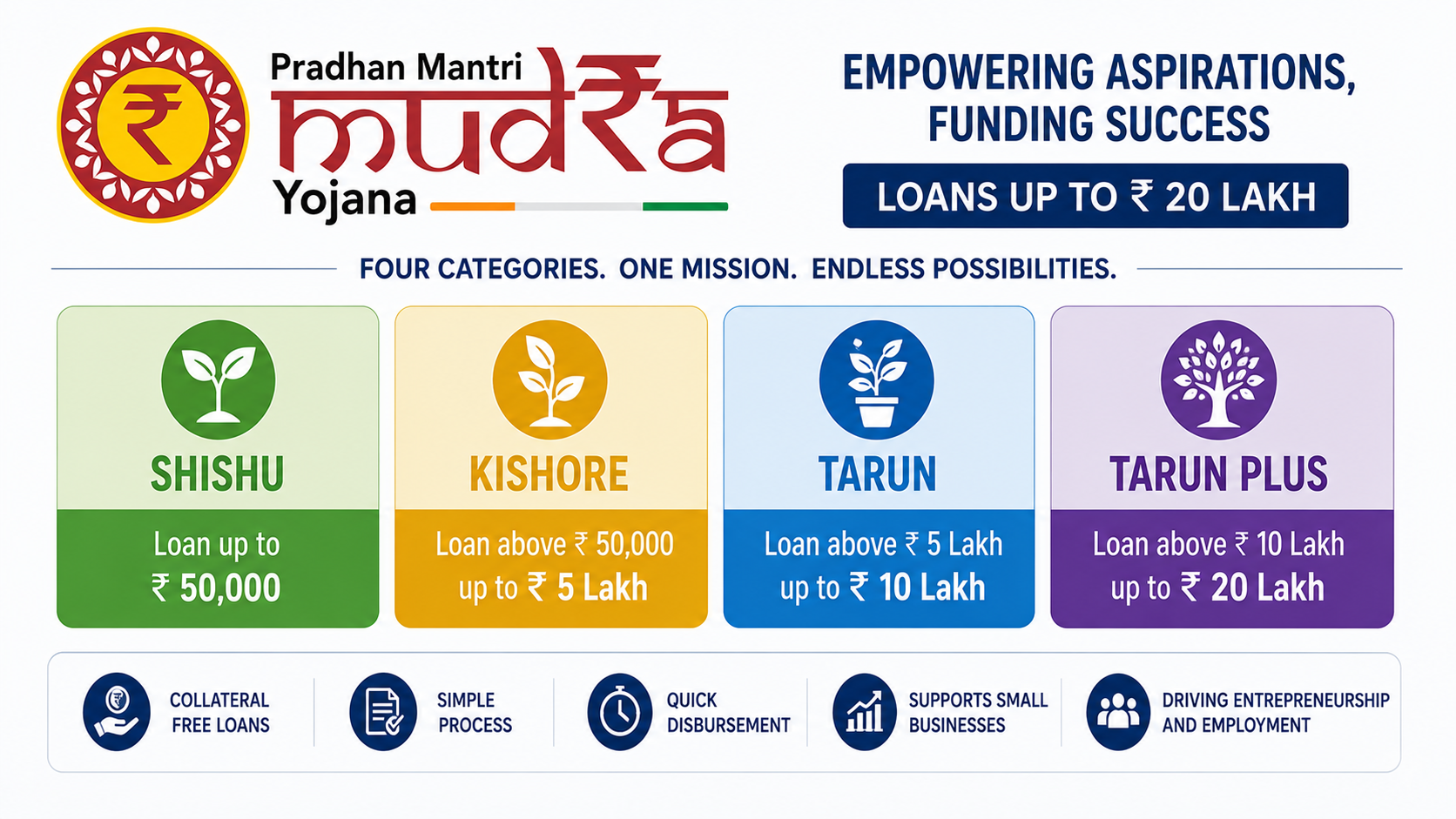
The scheme divides access to credit by business stage. A first-time borrower starts at Shishu. A business that has already used and repaid Tarun credit can move to Tarun Plus. The ladder is intentional.
| Category | Loan range | Who it is for |
|---|---|---|
| Shishu | Up to Rs 50,000 | New micro-businesses, first-time borrowers, very early stage |
| Kishore | Rs 50,001 to Rs 5 lakh | Existing businesses needing working capital or equipment |
| Tarun | Rs 5 lakh to Rs 10 lakh | Established businesses scaling up |
| Tarun Plus | Rs 10 lakh to Rs 20 lakh | Borrowers who have repaid a Tarun loan in full |
All four categories are collateral-free. No property, fixed deposit, or third-party guarantee is required at any level, including Rs 20 lakh. The Credit Guarantee Fund for Micro Units (CGFMU) provides the underlying guarantee that makes lenders willing to advance money without security.
There is no fixed minimum loan amount. If you need Rs 15,000, you can apply for that under Shishu.
2. Who qualifies for Tarun Plus – the real conditions
To be eligible for Tarun Plus:
- You must have previously taken a Mudra loan specifically under the Tarun category (Rs 5 lakh to Rs 10 lakh)
- That loan must have been fully repaid
- Your repayment record must be clean – no defaults, no restructuring, no NPA classification
These are not soft criteria that a bank can waive. Tarun Plus is a graduation pathway, not a higher loan limit available to anyone. The structure is deliberate: it creates a verifiable track record before significantly larger unsecured credit is extended.
Borrowers who previously held Shishu or Kishore loans are not eligible for Tarun Plus, regardless of repayment history. They would need to take a Tarun loan first, repay it, and then apply for Tarun Plus.
The bank that issued your original Tarun loan is the most natural place to apply for Tarun Plus. They already have your repayment history on record, which shortens verification considerably.
One practical note: not every bank and lender in the Mudra network has implemented Tarun Plus yet. HDFC Bank’s Mudra product page, for instance, currently shows only three categories with a maximum of Rs 10 lakh. Before spending time on an application, confirm with the specific branch that they offer Tarun Plus loans.
3. What businesses are eligible
Eligible:
- Shops, vendors, food stalls, small traders of any kind
- Small manufacturing units – textiles, garments, footwear, furniture, light engineering
- Service businesses – salons, tailoring, repair workshops, transport operators, tutoring centres
- Food processing – home-based or unit-based
- Allied agriculture: poultry farming, dairy, fisheries, beekeeping, horticulture, agri-equipment servicing
Not eligible:
- Crop loans and direct farming activities – ploughing, seeding, irrigation, land development
- Corporate entities – the scheme targets non-corporate micro and small businesses
- Businesses already meeting their full credit needs through other large credit schemes
Allied agriculture eligibility has expanded in recent years. Activities like mushroom cultivation, vermicomposting, and fish farming now fall within scope. If your business touches agriculture but is not direct crop farming, it is worth asking the bank whether your specific activity qualifies before ruling yourself out.
4. Interest rates and fees: what banks actually charge
The government does not set Mudra loan interest rates. Each lending institution sets its own based on its MCLR plus a spread, which is why the same category can carry a 9% rate at one bank and 14% at another.
Approximate market ranges for 2026:
| Category | Typical rate range |
|---|---|
| Shishu (up to Rs 50,000) | 8.5% to 12% per annum |
| Kishore (Rs 50K to Rs 5L) | 10% to 14% per annum |
| Tarun (Rs 5L to Rs 10L) | 11% to 16% per annum |
| Tarun Plus (Rs 10L to Rs 20L) | 12% to 18% per annum |
Public sector banks – SBI, Bank of Baroda, Bank of India – typically price lower than small finance banks, NBFCs, or micro-finance institutions. Women entrepreneurs and applicants from SC/ST/OBC communities may access preferential rates at some lenders; ask specifically when you apply.
Processing fees:
- Shishu: nil
- Kishore and Tarun: approximately 0.5% of the sanctioned amount
- No foreclosure charges at any category – you can repay early without penalty
Repayment tenure: Up to 7 years (84 months), with a moratorium of 6 to 12 months available for some loan types – meaning repayment can start after the business has had time to generate income from the investment.
5. Documents required by category
Shishu (up to Rs 50,000):
- Aadhaar card
- PAN card or Form 60
- Business address proof (utility bill, rental agreement, or a self-declaration accepted by some lenders)
- Two passport-size photographs
- Quote or invoice for equipment to be purchased, if applicable
No project report is required for Shishu. Banks are directed to process these applications within 7-10 working days. The documentation is intentionally light because Shishu borrowers are often first-generation creditors with no paper trail.
Kishore and Tarun (add to the above):
- Last 6 months’ bank statements
- Income Tax Returns if filed
- Udyam Registration Certificate (not mandatory, but recommended – it speeds processing and demonstrates the business is formally registered)
- Project report: a written business plan showing how the loan will be used, estimated costs, projected monthly revenue, and a rough repayment calculation
The project report does not need to be prepared by a CA or consultant. A clear, honest description of your business and your plan for the money is what the bank is looking for. Vague or template-copied reports slow approvals.
Tarun Plus (add to the above):
- Statement of the previous Tarun loan account, showing full disbursement and repayment history
- Loan closure certificate or NOC from the issuing bank
- Updated business financials and bank statements
- Detailed project report for the expansion being funded
6. How to apply
Online:
Two government portals handle Mudra applications digitally:
JanSamarth (jansamarth.in): Single-window platform for government-linked credit. Select Business Activity Loan, choose your Mudra category, fill your details, upload documents, and submit. You receive an application reference number and can track status online.
Udyami Mitra (udyamimitra.in): Dedicated MSME credit platform with a similar flow. Some borrowers find the interface more detailed here for Kishore and Tarun applications.
At a bank branch:
Walk into any public sector bank, private bank, Regional Rural Bank, Small Finance Bank, NBFC, or MFI and ask for the PMMY loan application form. Separate forms exist for Shishu and for Kishore/Tarun. Confirm which form applies before filling.
The loan amount, once sanctioned, is transferred directly to your business bank account. If your loan includes a working capital component, you may also receive a MUDRA Card.
7. The MUDRA Card: what it is and how it differs from a term loan
A term loan gives you the full sanctioned amount upfront. Interest accrues on the full amount from day one.
The MUDRA Card works differently. It is a RuPay debit card linked to a working capital credit limit. You draw from it as and when you need funds, up to the sanctioned limit. Interest is charged only on the amount actually withdrawn, not the full limit. A textile trader who needs Rs 80,000 for raw material this month and nothing next month pays interest only on that Rs 80,000 for the days it is outstanding.
This makes the MUDRA Card particularly useful for businesses with uneven or seasonal cash needs. You can repay and redraw within the limit, functioning like a revolving overdraft account.
Not all Mudra loans automatically include a MUDRA Card. Whether one is issued depends on the lender and the loan structure. Ask about it when discussing the sanction.
8. Pitfalls to avoid before you apply
Applying for Tarun Plus without a Tarun repayment record. Banks reject these immediately. The scheme is designed as a ladder; there is no shortcut to the top rung.
Going to a bank you have never dealt with. Your existing bank already has your transaction history. That familiarity makes assessment faster and more credible than approaching a bank cold.
Neglecting Udyam Registration. Banks cannot make Udyam mandatory, but applicants who have it move through verification faster. If you run an eligible business and have not registered at udyamregistration.gov.in, it takes 15 minutes and costs nothing.
Weak project reports for Kishore and Tarun applications. The report does not need to be elaborate, but it needs to show the bank that you understand how much the expansion will cost and how the business will service the debt. Generic reports copied from templates are easy for loan officers to spot.
Paying anyone to process your application. The next section covers this in detail.
Scam warning
Mudra loan applications are free. No agent, consultant, DSA, or self-described government representative has any official role in processing your application or guaranteeing your approval. If anyone asks you for cash, a UPI transfer, a commission, or any payment whatsoever to “process your Mudra loan” or “fast-track your approval,” walk away. The scheme charges nothing for applying.
Report fraudulent approaches on the PM Mudra Yojana helpline: 1800-180-1111 (toll-free) or 1800-11-0001 (toll-free). You can also write to mudra@mudra.org.in.
The official application portals are jansamarth.in and udyamimitra.in. Any other site claiming to be an official Mudra portal is likely fraudulent.
Frequently asked questions
I have been running my tailoring business for six years but never took a formal loan. Can I apply for Tarun directly?
Yes. There is no requirement to have previously borrowed under Shishu or Kishore before applying for Tarun. A first-time borrower with a clear business profile can apply for any category based on their credit requirement. The restriction applies only to Tarun Plus, which requires a Tarun repayment history.
My previous Mudra loan had a two-month delay in repayment due to the COVID period. Does that disqualify me from Tarun Plus?
A single delayed period that was later resolved may or may not affect eligibility depending on how your bank classified the account during that period. If the loan was never declared NPA and was closed without restructuring, your chances are reasonable. If it was formally restructured or went into NPA status, Tarun Plus eligibility will be affected. Ask your bank directly – they will check the account status and advise.
Can I use a Mudra loan to buy a commercial vehicle?
Transport businesses using vehicles for commercial purposes – goods transport, taxi, e-rickshaw – are among the eligible categories under PM Mudra Yojana. The loan can fund vehicle purchase in such cases. Agricultural tractors and farm vehicles used for pure farming are not covered.
Is there a Mudra loan subsidy?
There is no direct interest subsidy under the scheme. The benefit is collateral-free access to institutional credit, not a reduced rate. Some state government schemes run alongside Mudra and offer supplementary subsidies. Check your state’s MSME or Industries department portal for any state-specific parallel scheme.
I applied through JanSamarth three weeks ago and have heard nothing. What should I do?
Log in to jansamarth.in and check your application status. If it shows Under Process, the bank is working on it. If the status is stalled or unclear, visit the branch linked to the application. Digital applications are routed to a physical branch for final sanction – following up in person usually resolves delays faster than waiting.
My lender says my CIBIL score is too low for a Kishore loan. What are my options?
Shishu loans do not have a credit score requirement. If you need working capital below Rs 50,000, the Shishu category may be accessible even with no credit history. For larger amounts, Micro Finance Institutions and some Small Finance Banks participating in the Mudra network apply lighter credit score criteria than large commercial banks. Ask at multiple lenders.
Sources and disclaimer
Information is sourced from the official PM Mudra Yojana website (mudra.org.in), SBI’s PMMY product page, PIB releases on scheme statistics as of April 2026, and confirmed scheme guidelines from multiple lenders. Tarun Plus introduction date (October 24, 2024) sourced from Bajaj Finserv’s product guide. Interest rate ranges are indicative based on market data from multiple lending sources and vary by institution – confirm directly with your lender before applying. Scheme terms are subject to change; verify current guidelines at mudra.org.in before acting.
About the author
C. Thiruvenkatam is the founder and editor of Daily Hind News. He covers government welfare schemes, MSME finance, and civic guidance for small business owners, traders, and entrepreneurs across India. Daily Hind News explains government programmes in plain English so that real people can access what they are entitled to without being misled. Contact: dailylifearticles@gmail.com