NRE vs NRO vs FCNR (2026): Which Account for Salary, Rent and Savings — and How Each Is Taxed
By C. Thiruvenkatam | Daily Hind News | 10 June 2026
The account you should use is mostly decided for you — not by which one is “best,” but by where the money comes from. Foreign earnings go into an NRE or FCNR account. Money you earn inside India — rent, dividends, an Indian pension — goes into an NRO account. Get that single rule right and most of the confusion clears.
The choice gets framed as a contest, which is the wrong way to look at it. NRE vs NRO vs FCNR is not really about which account is better. It is about which one the rules let you use for a given rupee, and what tax follows.
Here is the second thing that trips up even careful people: putting money into an NRE account does not make that money tax-free. Only the interest an NRE account earns is exempt. Push taxable Indian income into it and the income stays taxable. Which account, and what tax — two separate questions. This page answers both.
The 60-second answer
| You want to… | Use | Why |
|---|---|---|
| Receive a salary you earn abroad | NRE | Foreign-source money; interest is tax-free in India; you can send the whole balance back out anytime |
| Receive rent, dividends or a pension from India | NRO | India-source income; this is where your tenant’s/payer’s TDS lands and where the income is tracked for tax |
| Save in rupees with full flexibility | NRE (savings or fixed deposit) | Tax-free interest, fully repatriable |
| Save without rupee risk | FCNR(B) | Held in foreign currency, tax-free, no exposure to a falling rupee |
Most NRIs end up holding more than one — typically an NRE account and an NRO account, and an FCNR deposit if they want to keep some money in dollars or pounds. That is normal and correct. Each does a job the others can’t.
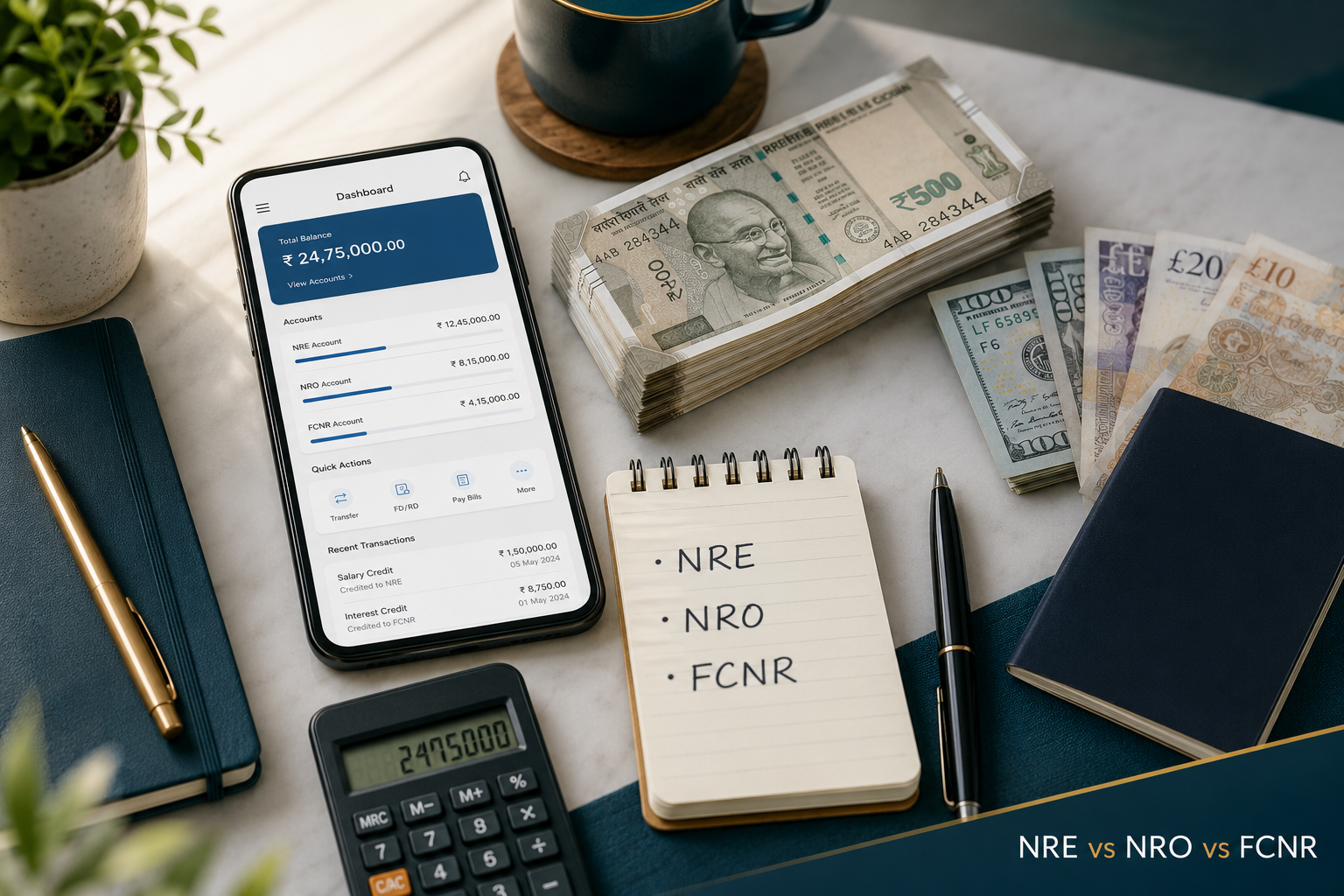
The three accounts at a glance
NRE (Non-Resident External). A rupee account for your foreign earnings. You remit money from abroad, the bank converts it to rupees, and both the principal and the interest are freely repatriable. Interest is tax-free in India.
NRO (Non-Resident Ordinary). A rupee account for income that arises in India — rent, dividends, interest, a pension, professional fees. The interest is taxable, and getting large sums out of the country is capped (more below).
FCNR(B) (Foreign Currency Non-Resident, Banks). A fixed deposit held in a foreign currency — US dollars, pounds, euros, yen and a few others — for one to five years. Because it never becomes rupees, a falling rupee can’t dent it. Interest is tax-free in India and the deposit is fully repatriable.
| Feature | NRE | NRO | FCNR(B) |
|---|---|---|---|
| Holds | Foreign earnings, in rupees | Income earned in India | Foreign earnings, in foreign currency |
| Currency | Indian rupees | Indian rupees | USD, GBP, EUR, JPY, CAD, AUD and others |
| Account types | Savings, current, RD, fixed deposit | Savings, current, RD, fixed deposit | Term deposit only (1–5 years) |
| Interest taxed in India? | No — exempt | Yes | No — exempt |
| Repatriation | Full, no cap | Up to USD 1 million per year, plus current income | Full, no cap |
| Rupee-depreciation risk | Yes | Yes | No |
| Best for | Foreign salary, rupee savings | Indian rent, dividends, pension | Foreign-currency savings, currency safety |
A practical note: balances in all three are covered by deposit insurance (DICGC) up to ₹5 lakh per depositor per bank — for FCNR, the cover is calculated after conversion to rupees.
How each one is taxed
This is where the real money is, so be precise.
NRE and FCNR interest is exempt from Indian income tax — for NRE under Section 10(4)(ii) of the Income Tax Act, and for FCNR under Section 10(15)(iv)(fa). No TDS is deducted on it. The exemption holds for as long as you qualify as a person resident outside India.
NRO interest is taxable. Banks deduct TDS at 30%, plus surcharge (if applicable) and a 4% health-and-education cess. For most NRIs that works out to about 31.2%. With surcharge on higher incomes it climbs higher — into the mid-30s and beyond. That is steeper than the rate a resident pays on the same interest.
Rent on Indian property is taxable too, and the deduction happens before the money even reaches you: your tenant is required to deduct TDS of roughly 31.2% from the very first rupee of rent — there is no exemption threshold, and they need a TAN to do it. This catches a lot of NRI landlords off guard.
| Income | Taxed in India? | TDS at source |
|---|---|---|
| Interest on NRE balance | No | Nil |
| Interest on FCNR deposit | No | Nil |
| Interest on NRO balance | Yes | 30% + surcharge + 4% cess (≈31.2% for most) |
| Rent on Indian property | Yes | ≈31.2%, deducted by the tenant |
Two things soften the NRO bite, and most people leave them on the table.
First, TDS is only a withholding, not your final bill. File an Indian income-tax return; if your actual liability is lower than what was deducted, you claim the difference back as a refund.
Second, a DTAA (Double Taxation Avoidance Agreement) between India and your country of residence often caps the tax on interest at a lower rate — frequently 10–15%. To use it, you generally need a Tax Residency Certificate from your country and Form 10F. You can also apply for a lower- or nil-deduction certificate under Section 197 (Form 13) so the bank or tenant deducts less up front instead of you waiting for a refund.
Which account for your salary
If you earn your salary abroad, remit it to your NRE account. It is foreign-source money, the interest it then earns is tax-free, and you can move the entire balance back out whenever you choose.
If you still draw a salary or professional fees in India — some NRIs do — that income arises in India and belongs in your NRO account, where it is taxable.
One trap to avoid: once your status changes to non-resident under FEMA, your old resident savings account cannot keep running. It has to be redesignated as an NRO account. Continuing to operate a resident account as an NRI is a FEMA breach, and a foreign salary should never be paid into it.
Which account for rent and Indian income
By default, Indian rent goes into your NRO account. That is where your tenant’s TDS lands and where the income sits cleanly for your tax return.
Now the nuance that most articles get wrong. RBI does allow “current income” — rent, dividends, pension, interest — to be credited to an NRE account, net of tax, provided your bank is satisfied the tax has been accounted for. So it is not strictly forbidden. But be clear about what that does and doesn’t do: it can make the money easier to send abroad, but it does not make the rent tax-free. The NRE exemption is for interest the account earns, not for Indian income you deposit into it. For most landlords the clean route is simple — rent into NRO, tax sorted, repatriate what you need.
Which account for savings — NRE or FCNR?
Both protect your foreign earnings and both pay tax-free interest. The real choice is about currency risk.
Choose NRE (savings or fixed deposit) if you want rupee growth and full flexibility. Rupee deposit rates are usually higher than foreign-currency rates, the interest is tax-free, and you can repatriate anytime. The catch is exactly that it is in rupees: if the rupee weakens against your home currency, your balance buys fewer dollars or pounds when you convert.
Choose FCNR(B) if you want that currency risk gone. You hold and earn interest in USD, GBP, EUR and the like, so a falling rupee can’t touch it. The trade-offs: it is a term deposit only (one to five years — there is no savings version), you usually get no interest if you break it inside the first year, and the foreign-currency interest rate is typically lower than the rupee rate. You are paying, in yield, for the safety.
A simple illustration. Say you put the equivalent of $10,000 into an NRE rupee fixed deposit when the rate is ₹86 to the dollar. A year later the rupee has slipped to ₹90. Your rupee balance and interest are fully intact — but converting back gets you fewer dollars than you started with. The same $10,000 in an FCNR dollar deposit stays $10,000, plus dollar interest, untouched by the move. Which you’d prefer depends on whether you expect to spend that money in rupees or back home.
Interest rates change constantly and differ by bank, currency and tenure, so compare the current rates on offer before you lock anything in.
Getting money out: repatriation rules
NRE and FCNR: fully repatriable, no cap, minimal paperwork. The money was foreign to begin with, so it goes back out freely.
NRO: more regulated. You can repatriate balances up to USD 1 million per financial year (April–March), across all your NRO accounts combined, after tax. Each such transfer needs Form 15CA (your online declaration) and usually Form 15CB (a chartered accountant’s certificate).
A point worth knowing: your current income — rent, dividends, pension, interest — is freely repatriable and sits outside that USD 1 million ceiling. The cap is for moving capital, like property-sale proceeds. So routine income coming out of an NRO account isn’t eating into your million-dollar limit.
This is why many NRIs first move money from NRO to NRE (after paying the tax and filing the forms) and then remit abroad from the NRE side, which has no restrictions.
What nobody tells you (and the costly mistakes)
Crediting Indian income to NRE does not launder it tax-free. Said again because it costs people money and audit trouble: the exemption is on interest the account earns, not on what you deposit.
An inoperative PAN can mean higher TDS. If your PAN gets flagged inoperative — something a number of NRIs have run into — tax can be deducted at a steeper rate. Check your PAN status and make sure your non-resident status is correctly updated with the Income Tax Department.
Joint accounts have a strict shape. Two NRIs/PIOs can hold any of these jointly. A resident close relative can be added to an NRE, NRO or FCNR account only on a “former or survivor” basis — you operate it in your lifetime, and the relative can act during that time only as a Power-of-Attorney holder, taking over fully after you. “Close relative” follows the Companies Act definition (spouse, parents, children, siblings and so on) — friends and cousins don’t qualify.
Breaking an NRE fixed deposit early to “convert” it on return is usually a mistake — see the next section.
Ignoring the RNOR window after you return quietly costs returning NRIs a lot of tax. Again, next section.
When you move back to India
The moment your status flips to resident under FEMA, the clock starts. RBI’s rules are specific:
- NRE accounts must be redesignated as resident accounts, or the funds moved to an RFC (Resident Foreign Currency) account, at your option, immediately on your return. You can’t keep operating an NRE account once you’re resident.
- NRO accounts are redesignated as resident accounts on your return.
- FCNR(B) deposits may run to maturity at the contracted rate, if you want — you do not have to break them. On maturity, the bank converts them to a resident rupee deposit or, if you’re eligible, an RFC account.
That FCNR/NRE deposit rule saves real money, and bank staff sometimes get it wrong. If you opened a five-year NRE fixed deposit two years ago at a good rate, you do not have to smash it on day one of being resident and accept today’s lower resident rate — it can be redesignated and left to mature. If a branch pushes you to break it, point them to RBI’s Master Direction on deposits and the redesignation rules.
There’s also the RNOR point. For a transitional period after returning — commonly two to three years, depending on your past residency — you may qualify as Resident but Not Ordinarily Resident. During that window your foreign income is largely outside the Indian tax net, and FCNR/RFC interest generally stays exempt until you become an ordinary resident. Confirm whether and for how long RNOR applies to you; it is one of the most valuable, most overlooked planning windows for returning NRIs.
Staying safe from NRI banking scams
Opening any of these accounts is free. No bank, “agent” or “RBI officer” needs your OTP, password or full card number to do it.
Three scams target NRIs specifically: someone offering to “open your NRE account” or “release blocked NRO funds” for a fee; a caller claiming to be from the Income Tax Department or RBI demanding payment to “clear a tax block” on a transfer; and fake “DTAA refund agents.” RBI and the tax department do not phone individuals to collect money.
If money has already been lost to online financial fraud, call 1930 (the national cyber-fraud helpline) or report at cybercrime.gov.in. You can also raise complaints about a regulated bank at RBI’s Sachet portal, sachet.rbi.org.in. Deal only with your bank’s official NRI desk and the government’s own .gov.in portals.
For the paperwork side of moving money, see our guides on filing your Income Tax Return as an NRI, Form 15CA and Form 15CB explained, how DTAA helps NRIs avoid double tax, and keeping your PAN active as an NRI.
FAQ
Can I keep my old resident savings account after becoming an NRI? No. Once your status changes under FEMA, that account must be redesignated as an NRO account. Running a resident account as an NRI breaches FEMA.
If I earn a salary in India, can it go into my NRE account? No. Indian salary is India-source income and belongs in your NRO account, where it’s taxable. NRE takes foreign earnings.
Does crediting my Indian rent to an NRE account make it tax-free? No. The NRE exemption covers interest the account earns, not income you deposit. Rent stays taxable wherever it lands.
NRO interest is taxed at over 30%, but I’m in a low bracket — am I overpaying? TDS is only a withholding. File an Indian return and claim any excess back as a refund. A DTAA rate or a Section 197 lower-deduction certificate (Form 13) can also reduce what’s deducted up front.
Can I hold all three accounts at once? Yes, and many NRIs do: NRE for foreign income and rupee savings, NRO for Indian income, FCNR for foreign-currency deposits.
Can my spouse abroad or a parent in India be a joint holder? Yes. Two NRIs/PIOs can hold jointly. A resident close relative can be added on a “former or survivor” basis — you operate the account in your lifetime; they take over after.
Is there an FCNR savings account? No. FCNR(B) is a term deposit only, one to five years. Break it inside the first year and you usually earn no interest.
How NRIs Can Open an Indian Bank Account Online in 2026: NRE, NRO and FCNR Accounts Explained Simply
Sources and disclaimer
Details here are drawn from the Reserve Bank of India’s FAQ, Accounts in India by Non-residents, and its Master Direction on Deposits and Accounts; the FEMA framework; and the Income Tax Act, including the NRE and FCNR interest exemptions under Sections 10(4)(ii) and 10(15)(iv)(fa). TDS rates follow the Finance Act and carry surcharge and cess that vary with income and change with each year’s Budget.
This is general information, not tax or legal advice. Account rules, repatriation limits, TDS rates and DTAA benefits depend on your residential status, your country of residence and the financial year. Confirm the current position for your own situation at rbi.org.in and incometax.gov.in, or with your bank’s NRI desk and a qualified chartered accountant, before you act.
About the author
C. Thiruvenkatam is the founder and editor of Daily Hind News, where he writes and edits plain-English guidance on government schemes, official documents, banking and NRI services for readers in India and abroad. His focus is turning dense official rules into usable steps. Editorial contact: dailylifearticles@gmail.com.