OCI vs PIO vs NRI: What Each Status Actually Allows in India (Property, Voting, Work, Aadhaar)
By C. Thiruvenkatam | Daily Hind News | 10 June 2026
Start with the correction that clears up most of the confusion: NRI and OCI are not two versions of the same thing, and PIO is no longer a thing at all.
An NRI is an Indian citizen who happens to live abroad — same passport, same core rights, with the open questions mostly about tax. An OCI cardholder is a foreign citizen of Indian origin holding a lifelong visa to India — not citizenship, and not a vote. And the PIO card? It was folded into OCI back in 2015, and the facility to convert an old PIO card to OCI closed for good on 31 December 2025.
So when people ask about OCI vs PIO vs NRI, the honest answer is that you are really choosing between two states: an Indian citizen abroad, or a foreign citizen of Indian origin. The thing that flips you from the first to the second is taking another country’s passport — because India does not allow dual citizenship. Almost everything on this page follows from that single fact.
This guide covers what each status actually lets you do on the four questions people ask most: property, voting, work, and Aadhaar.
The one distinction that explains everything
Citizenship.
An NRI holds an Indian passport. They are a citizen who lives outside India — the term comes from residence and tax law, not from any card. Under FEMA and the Income Tax Act, “non-resident” is decided by how long you stay in India, and the two laws even define it slightly differently. But the passport stays Indian.
An OCI cardholder holds a foreign passport. They gave up (or never had) Indian citizenship, and the OCI card is a lifelong, multiple-entry visa that lets them live, work and travel in India indefinitely. It is widely — and wrongly — called “dual citizenship.” It isn’t. India does not permit dual citizenship, and an OCI card carries neither a vote nor the right to a government post.
A PIO cardholder, today, is really an OCI applicant. The scheme is closed. If you are holding a PIO card, it is no longer a valid travel document, and you cannot convert it anymore — you apply for OCI afresh.
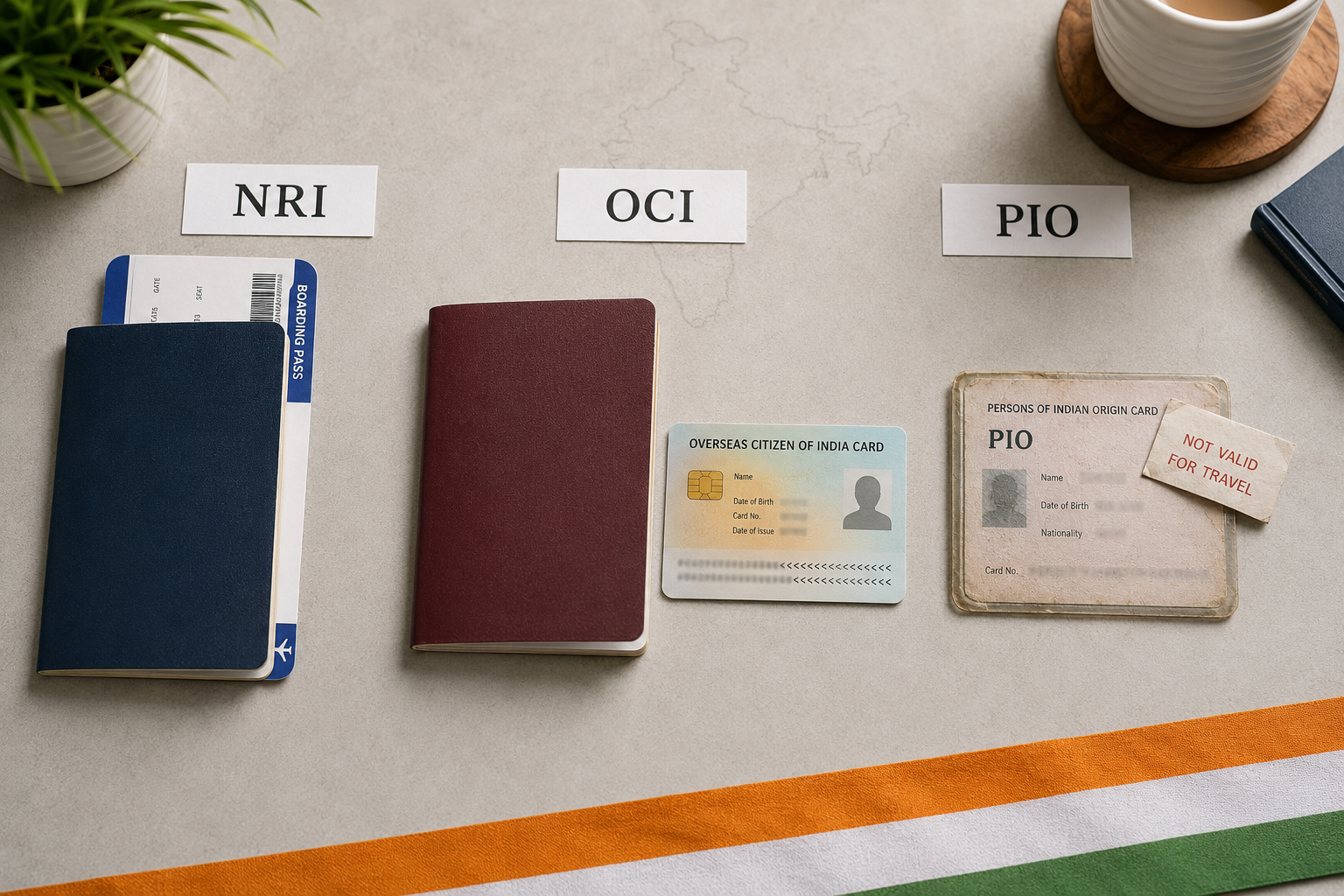
OCI vs PIO vs NRI at a glance
| NRI | OCI cardholder | PIO card | |
|---|---|---|---|
| Who | Indian citizen living abroad | Foreign citizen of Indian origin | Defunct — merged into OCI |
| Passport | Indian | Foreign | — |
| What it is | A residential/tax status (not a card) | A lifelong visa (not citizenship) | A closed card scheme |
| Visa to enter India | Not needed | Not needed (visa is on the OCI card) | No longer valid for travel |
| Vote in India | Yes — in person only | No | No |
| Govt job / constitutional post | Yes | No | No |
| Buy residential/commercial property | Yes | Yes | (treated as OCI) |
| Buy agricultural land / farmhouse | No (can inherit) | No (can inherit) | No |
| Aadhaar | Yes — no 182-day wait | Yes — only after 182 days’ stay | (treated as OCI) |
| Register with FRRO | Not applicable | Exempt, for any length of stay | — |
| Taxed in India on | India-source income, by residential status | Same — decided by days of stay, not the card | — |
Property: what each can and can’t buy
Here, NRIs and OCI cardholders are on the same footing, and it’s a generous one with one hard line.
Both can buy as many residential and commercial properties as they like in India, and pay through normal banking channels. There is no cap on the number.
Neither can buy agricultural land, a farmhouse, or plantation property. This is a firm restriction under India’s foreign-exchange rules, and it doesn’t matter how Indian your roots are. The one exception is that such land can come to you by inheritance, or as a gift from a relative who is a resident Indian — you can receive it, you just can’t go out and purchase it.
A PIO cardholder’s position is simply the OCI position, because that is what the card now is.
Voting: only one of these can vote
This is where the citizenship line bites hardest.
An NRI can vote — because an NRI is still an Indian citizen. You register as an “Overseas Elector” under Section 20A of the Representation of the People Act, using Form 6A, which you can file online at voters.eci.gov.in from abroad. Your name goes into a separate “Overseas Electors” section of the roll for the constituency tied to the address in your passport.
But there’s a catch that surprises people every election: to actually cast the vote, you must be physically present at your polling station on poll day, with your original Indian passport. There is no postal ballot or proxy vote for NRIs yet — the electronically-transmitted postal ballot has been discussed for years but is not in force for overseas electors. No flight home, no vote.
An OCI cardholder cannot vote. Full stop. OCI confers no electoral rights, and Form 6A explicitly excludes citizens of other countries.
A trap worth naming: if you were an Indian citizen, registered to vote, and then naturalised abroad, your old voter entry doesn’t vanish on its own. Casting a vote in India after you’ve become a foreign citizen is an electoral offence. The clean step is to get your name removed from the roll when you take the foreign passport.
Work and employment
An NRI works in India freely — a citizen needs no permission.
An OCI cardholder can work in India too, and for most purposes is treated like an NRI: private-sector jobs, business, and even regulated professions such as doctor, dentist, nurse, pharmacist, advocate, architect or chartered accountant — the last group subject to the rules of the relevant professional council, the same as for NRIs. OCI cardholders are also exempt from registering with the FRRO/FRO no matter how long they stay.
What an OCI cardholder cannot do:
- Hold a government job — appointment to public services and posts under the Union or a State is not open to them, barring special appointments the Central Government may notify.
- Hold a constitutional post — President, Vice-President, Supreme Court or High Court judge, or membership of Parliament or a State legislature.
And a set of activities need prior special permission from the relevant authority, under the March 2021 MHA notification that placed OCI cardholders, for these purposes, in the same bracket as any foreign national: research, missionary or Tabligh work, journalistic activity, mountaineering in notified areas, internships in government or quasi-government bodies, employment in foreign diplomatic missions in India, and any visit to a Protected, Restricted or Cantonment area (an Inner Line Permit or PAP is still required).
The underlying principle of that notification matters: on anything not specifically granted, and not covered by FEMA, an OCI cardholder is treated as a foreigner, not as an NRI. The parity is real but it is bounded.
Aadhaar: the rules are different for each
People assume Aadhaar works the same for everyone of Indian origin. It does not, and the difference is one of the cleaner practical splits between NRI and OCI.
An NRI with a valid Indian passport can enrol straight away — there is no 182-day waiting period. UIDAI’s own position is explicit: an NRI, whether adult or minor, with a valid Indian passport can apply at any enrolment centre, and the residential condition of 182 days is not mandatory. The Indian passport does most of the documentary work. (If a centre still insists on a 182-day stay, that’s an outdated practice — UIDAI’s rule changed after the 2019 Budget.)
An OCI cardholder must wait. Because they’re treated as a resident foreign national, they can enrol only after staying in India for 182 days or more in the 12 months immediately before the application date — and that’s 182 days in the preceding twelve months, not a calendar or financial year. Adults use Form 7, minors use Form 8, and an Indian address is needed. Without proof of the 182-day stay, the application is rejected at the centre.
For both, Aadhaar is optional, not mandatory — you can open NRE/NRO accounts, get a SIM and complete KYC without it. It’s just convenient to have during longer stays.
If you still hold a PIO card
The position in 2026 is blunt, and it’s straight from the government: the PIO-to-OCI conversion facility was discontinued after 31 December 2025, and is no longer available. PIO cardholders who want OCI must now apply afresh for OCI registration under the normal rules.
So if a PIO card is sitting in your drawer:
- It is not a valid travel document. Don’t rely on it to enter India; an airline can refuse boarding.
- The old, sometimes fee-waived “OCI in lieu of PIO” route is gone. A fresh OCI application at standard fees is the path.
- Use the PIO card as one of your proofs of Indian origin in that fresh application.
Who can actually get OCI
OCI is for foreign nationals with a genuine Indian-origin link. In broad terms, you qualify if you:
- were ever an Indian citizen, or held an Indian passport; or
- were eligible to become an Indian citizen on 26 January 1950, or were a citizen on/after that date; or
- belonged to a territory that became part of India after 15 August 1947; or
- are a child, grandchild or great-grandchild of such a person; or
- are a minor child where at least one parent is an Indian citizen; or
- are a foreign-origin spouse of an Indian citizen or an OCI cardholder, where the marriage has been registered and has subsisted for at least two continuous years before you apply.
There is one disqualifier that overrides everything: anyone who has ever been a citizen of Pakistan or Bangladesh — or whose parents, grandparents or great-grandparents were — is not eligible for OCI. Foreign military or police service can also bar an application.
If you were an Indian citizen who acquired foreign citizenship after 1 June 2010, you’ll generally need a Surrender Certificate for your Indian passport before, or alongside, the OCI application.
Fees and timelines move, so confirm them before you pay — at the time of writing, OCI fees are around [Confirm current fee at ociservices.gov.in] US$275 for an adult and US$25 for a minor abroad (about ₹15,000 if applying in India), with processing typically of a few weeks. Apply through ociservices.gov.in and your country’s authorised VFS/BLS centre.
The moment an NRI becomes an OCI
This transition catches people out, so treat it as a checklist, not an afterthought.
The instant you voluntarily acquire another country’s citizenship, you cease to be an Indian citizen — automatically, under the Citizenship Act. There is no dual-citizenship option. From that day:
- Surrender your Indian passport and obtain a Surrender Certificate.
- Apply for OCI if you want to keep a long-term relationship with India — accepting that the vote and government posts are not part of it.
- Get your name removed from the electoral roll in your old constituency.
- Convert your bank accounts. Your resident savings account must become an NRO account, and you’ll likely want NRE/FCNR accounts for foreign earnings. We covered exactly how each works, and how each is taxed, in our guide to NRE vs NRO vs FCNR accounts.
Tax: it follows your days, not your label
A common and expensive misunderstanding: people think “OCI” or “NRI” is a tax status. It isn’t.
Tax in India is decided by your residential status for the year, which turns on how many days you spend in India — not on which passport or card you hold. An OCI cardholder who stays long enough to become a resident is taxed as a resident, on worldwide income. An Indian citizen abroad who qualifies as non-resident is taxed only on India-source income. The card in your wallet doesn’t change that arithmetic; your travel calendar does.
For how that plays out across savings, salary and rent — and the tax-free versus taxable accounts — see the NRE/NRO/FCNR guide linked above, and our explainer on filing an Income Tax Return as an NRI.
What nobody tells you
The PIO card is dead, and carrying it can get you stuck at the gate. It is not a travel document in 2026.
OCI is not dual citizenship, and not an automatic route to it. It’s a lifelong visa. An OCI cardholder can later apply for Indian citizenship by registration, but only after separately meeting the residence conditions — it isn’t conferred by the card.
OCI never carries a vote — not even if you were once an Indian citizen and once voted. And voting after you’ve naturalised abroad is an offence, not a loophole.
Keep your OCI passport details updated on the portal. For a card issued when you were a minor, you must get a fresh OCI card once after you turn 20 and get a new passport. Between 21 and 49 it’s generally not required to re-issue for each new passport, but you’re expected to upload the new passport details on ociservices.gov.in — and people are refused boarding for skipping this. Rules around re-issue at 50 have been eased in recent years; check the current requirement on the portal before you travel. [Editor: confirm the present age-50 re-issue rule at ociservices.gov.in — official consulate pages still vary on this.]
Don’t keep operating your old resident bank account or voter ID after you become an OCI. Both need to change; running them on is a compliance problem, not a convenience.
Agricultural land is a one-way street — you can inherit it, but you can’t buy it, as an NRI or an OCI.
Staying safe from OCI and visa scams
OCI and visa applications go through one official channel: ociservices.gov.in and the authorised VFS/BLS centre for your country. Fees are fixed and published.
No “agent” can buy you a faster approval, a guaranteed result or “special clearance” — anyone promising that is a red flag. Never hand your passport scans, OTPs or card details to unofficial “OCI help” numbers you found through a search ad or a social-media post. For Aadhaar questions, use UIDAI’s helpline 1947. If you’ve already lost money to online fraud, call 1930 (the national cyber-fraud helpline) or report at cybercrime.gov.in.
FAQ
I have an OCI card and I used to be an Indian citizen — can I vote? No. OCI carries no vote, regardless of your history. Only Indian citizens can vote, and only in person.
I’m an NRI with an Indian passport — must I stay 182 days to get Aadhaar? No. With a valid Indian passport you can enrol on arrival; the 182-day condition does not apply to NRIs. It does apply to OCI cardholders.
I still hold a PIO card. Is it valid? Can I convert it? It is not valid as a travel document, and the conversion facility closed on 31 December 2025. Apply for OCI afresh, using the PIO card as proof of origin.
Can an OCI cardholder buy a flat in India? Yes — residential and commercial property, with no limit on the number. Not agricultural land, a farmhouse or plantation property.
Can an OCI cardholder take a job in India? Yes for most private employment and several regulated professions, on par with NRIs. No for government service and constitutional posts, and some activities (research, journalism, missionary work and others) need prior permission.
Does holding an OCI card mean I’m taxed as a resident? No. Tax depends on your days of stay in India for the year, not on the card.
I’m about to take foreign citizenship. What happens to my Indian one? You lose it automatically — India allows no dual citizenship. Surrender your Indian passport, get a Surrender Certificate, remove your name from the voter roll, convert your bank accounts, and apply for OCI if you want to keep your ties to India.
Can my foreign-citizen spouse get OCI? Yes, if your marriage is registered and has subsisted for at least two continuous years before applying, and they’re otherwise eligible (not of Pakistani or Bangladeshi origin).
Sources and disclaimer
Details here are drawn from the Ministry of Home Affairs and Indian consular notices on OCI and the closed PIO scheme (ociservices.gov.in and the OCI Notification of 4 March 2021 under Sections 7A/7B of the Citizenship Act, 1955); the Reserve Bank of India / FEMA framework on property and accounts; UIDAI’s official FAQ on NRI Aadhaar; and the Election Commission of India on overseas electors. The PIO-conversion cut-off (31 December 2025) is per Government of India / consular notifications.
This is general information, not legal, immigration or tax advice. Citizenship, visa, property and tax rules depend on your nationality, your residential status and the year, and they change. Confirm the current position for your own case at the official portals above — and, for your specific state or district, with the relevant authority or a qualified professional — before you act.
NRE vs NRO vs FCNR (2026): Which Account for Salary, Rent and Savings – and How Each Is Taxed
How NRIs Can Open an Indian Bank Account Online in 2026: NRE, NRO and FCNR Accounts Explained Simply
About the author
C. Thiruvenkatam is the founder and editor of Daily Hind News, where he writes and edits plain-English guidance on government schemes, official documents, banking and NRI services for readers in India and abroad. His focus is turning dense official rules into steps people can actually follow. Editorial contact: dailylifearticles@gmail.com.