Still Using Your Old Savings Account as an NRI? Here’s What FEMA Penalties Actually Look Like
Still Using Your Old Savings Account as an NRI? Here’s What FEMA Penalties Actually Look Like
By C. Thiruvenkatam | Daily Hind News | 04 July 2026
If you moved abroad and never got around to converting your regular Indian savings account, you are sitting on a FEMA violation right now, whether or not anyone has told you so. The rule is simple: once you become a non-resident, you cannot continue holding a resident savings account. You convert it to an NRO account, or you close it. Nobody sends you a notice when your status changes. The obligation is yours to act on, and most people only find out it existed when a bank or broker flags the mismatch years later.
Here is what actually counts as a violation, what enforcement really looks like in 2026, and how to fix it before it becomes expensive.
When you actually became an NRI under FEMA (it’s not quite the rule most sites quote)
Most guides on this topic borrow the Income Tax Act’s residency test – roughly 182 days outside India in a financial year – and apply it to FEMA too. That is not quite right, and the difference matters for exactly when your obligation to convert your account began.
FEMA’s definition, under Section 2(v) of the Act, does count days, but it also weighs intent. If you left India for a job abroad, for business, or for any purpose showing you plan to stay outside India for an uncertain period, you can become a “person resident outside India” from the point your circumstances show that intent – not only after you cross a day count. Two people who left India on the same flight can have different FEMA statuses within the same year, depending on why they went and what their plans were.
Practically, this means your bank account obligation may have started earlier than your income tax residency did. If you took up a permanent overseas job in March, you did not need to wait until September to become FEMA non-resident.

What the resident-account rule actually requires
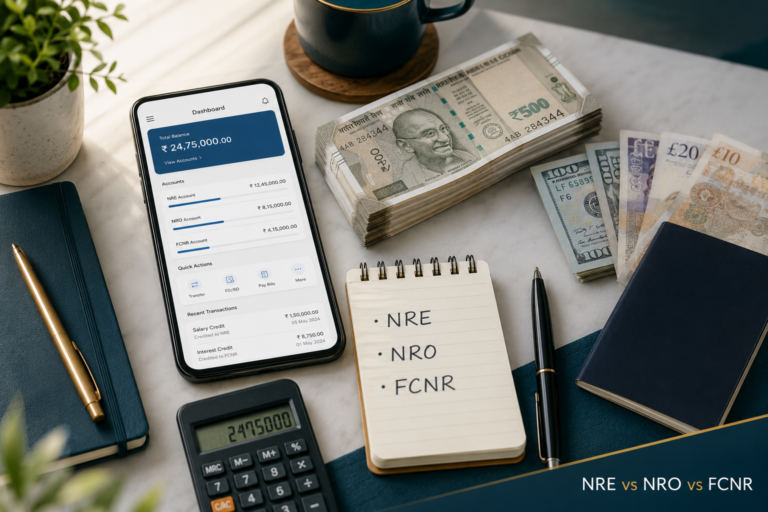
Once your status changes, FEMA does not allow you to keep a standard resident savings account. You have two options: convert it to an NRO account, which handles income earned in India and allows repatriation up to USD 1 million per financial year, or close it altogether and open a fresh NRO or NRE account. We cover the full differences between NRE, NRO, and FCNR accounts in our dedicated comparison guide – worth reading if you have not settled on the right account type yet.
There is no fee for converting an existing account, and most major banks now offer video KYC, so you do not need to fly back to a branch in India to do it.
How this actually gets caught
This is the part most coverage skips. Banks are not actively hunting for NRIs with the wrong account type on day one. The mismatch usually surfaces in one of these ways:
- KYC re-verification. Banks periodically re-check customer details, and an address abroad on file next to an active resident savings account is an obvious flag.
- Demat and trading accounts. NRIs need a separate NRI demat account and a PIS (Portfolio Investment Scheme) account to trade Indian shares. If your broker discovers you have been trading through a resident demat account while holding NRI status, they can freeze the account and report the transactions – this is often how people first learn they were non-compliant, sometimes years after the fact.
- Mutual fund folio checks. Asset management companies increasingly cross-check bank account type against declared residential status during redemptions.
None of these require you to have done anything dishonest. Simply not updating your bank after a job move abroad is enough to create the mismatch.
The real penalty math
FEMA violations fall under Section 13 of the Act, and enforcement runs through the Enforcement Directorate. For a quantifiable violation like this one, the penalty is up to three times the amount involved in the transaction, or Rs 2 lakh, whichever is higher. If the violation continues after it’s identified, an additional Rs 5,000 per day can apply for as long as it stays unresolved.
Take a concrete case: if you kept operating a resident account and routed Rs 15 lakh through it after your NRI status began, the exposure is not a flat fine – it is potentially three times that amount, well above Rs 2 lakh, before you even get to the daily penalty for the delay in fixing it.
In practice, most first-time, non-deliberate cases get resolved through the RBI’s compounding process rather than a full Enforcement Directorate proceeding – you disclose the lapse, pay a compounding fee that is typically far smaller than the maximum statutory penalty, and the matter closes. But that route works far better if you approach it before a bank or broker escalates the discovery themselves.
Fixing it now
- Contact your bank and ask specifically for “resident to NRO conversion,” not just a general account update.
- Provide proof of your NRI status – passport, current visa or residence permit, and an overseas address.
- Update your PAN records with your current address and residential status.
- If you hold demat or mutual fund accounts, update the linked bank details and residential status with each institution separately – a bank-side conversion does not automatically update your broker or AMC.
- If you have already been operating non-compliantly for a while, consider consulting a FEMA-specialist chartered accountant about voluntary compounding before an institution flags it for you.
[Editor: if you’ve walked a reader through this conversion process directly, note which bank and roughly how long it took – actual turnaround times vary a lot between institutions and would strengthen this section.]
Other silent violations hiding in the same mistake
Converting your bank account is the headline fix, but a few related traps catch people at the same time:
- PPF accounts. You cannot open a new PPF account as an NRI. An existing PPF account opened while you were a resident can usually run to maturity, but you cannot extend it beyond that or open a new one.
- Small savings schemes and NBFC deposits. These generally are not available to NRIs at all, even through a converted account.
- Joint accounts with resident family members. These are allowed under specific structures, but they follow different rules from a simple NRO conversion, and getting the structure wrong creates its own compliance question.
Common questions
I’m a student studying abroad. Does this apply to me?
Students abroad are treated as NRIs under FEMA and are generally eligible for the same account facilities, so yes, the same conversion principle applies, even though your circumstances differ from someone who moved for a permanent job.
What if I only plan to stay abroad temporarily, for a year or two?
This is exactly where FEMA’s intent test matters. A short posting abroad with a clear return date may not trigger non-resident status the way an open-ended move does. If your situation is genuinely ambiguous, get a specific opinion from a CA rather than guessing.
Can I keep my resident account open just to receive rent or dividends?
No. Income earned in India after your status changes should route through an NRO account, not a resident savings account, regardless of the source.
Does this apply to OCI cardholders the same way?
OCI cardholders who are foreign citizens follow FEMA’s non-resident rules in the same way NRIs do for banking purposes, since the account rules are based on residential status, not citizenship.
I already got flagged by my bank. What now?
Complete the conversion immediately and keep documentation of when you initiated it. If the bank or broker has already reported a specific transaction, consult a FEMA-specialist CA about the RBI’s compounding process rather than waiting to see what happens next.
Sources and disclaimer:
This article draws on FEMA’s statutory definition of person resident outside India under Section 2(v), RBI guidance on NRE, NRO, and FCNR accounts, and published penalty provisions under Section 13 of the Act, cross-checked against multiple NRI banking advisory sources. Individual circumstances vary, particularly around the intent-based test for residential status. This is not legal advice. Confirm your specific status and any corrective steps with a FEMA-specialist chartered accountant or lawyer before acting.
About the author: C. Thiruvenkatam is the founder and editor of Daily Hind News, where he covers NRI banking, taxation, and government schemes for readers in India and abroad.