JoSAA 2026 Counselling: Round 1 Fee Deadline is Today, Round 2 is June 30 – What You Must Do Right Now
JoSAA 2026 Counselling: Round 1 Fee Deadline is Today, Round 2 is June 30 – What You Must Do Right Now
By C. Thiruvenkatam | Daily Hind News | 22 June 2026
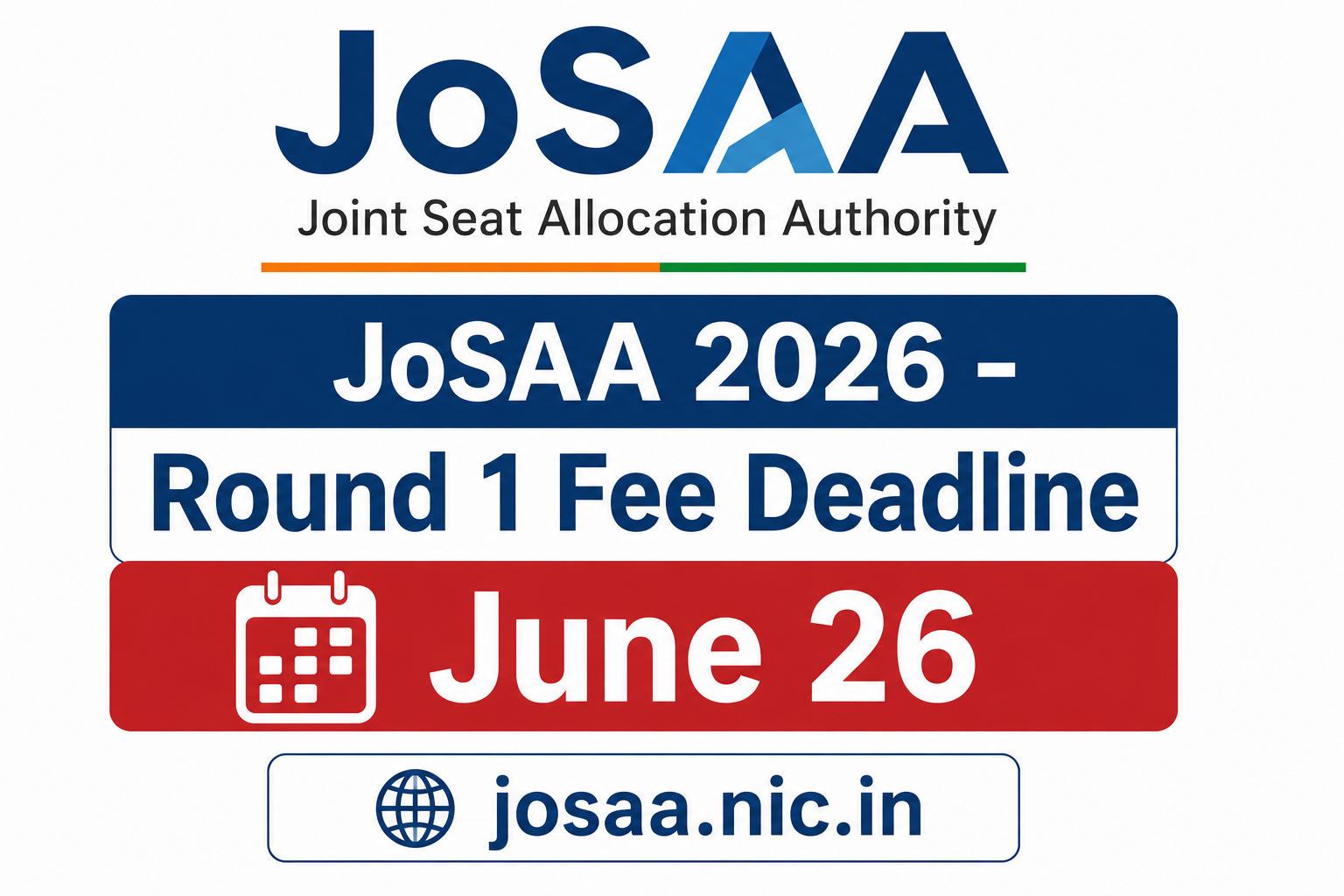
If you have a Round 1 JoSAA seat allotment, the fee payment deadline is June 26, 2026 at 5:00 PM. That is today. Missing it does not give you a second chance – it cancels your seat and removes you from all subsequent rounds permanently.
If you are still waiting for a better allotment, Round 2 results come out June 30.
Official portal for everything: https://josaa.nic.in
This article covers where the counselling stands right now, what Float/Freeze/Slide actually mean in practice, the decisions that catch students off guard, and what happens if you do not get a seat in any of the five rounds.
Table of Contents
- The complete round-wise schedule
- Round 1 is live – what to do today
- Float, Freeze, and Slide: a real decision framework, not just definitions
- The home state NIT advantage that changes the math
- IIT lower branch vs NIT top branch: how to think about it
- Document verification queries – why ignoring them cancels your seat
- CSAB: the post-JoSAA backup for NIT+ candidates
- Fees, refunds, and what gets deducted if you withdraw
- Frequently asked questions
1. The complete round-wise schedule
| Round | Allotment | Fee payment deadline | Withdrawal window |
|---|---|---|---|
| Round 1 | June 13, 2026 | June 26, 5:00 PM – TODAY | – |
| Round 2 | June 30, 5:00 PM | July 3, 5:00 PM | July 1-3 |
| Round 3 | July 6, 5:00 PM | July 8, 5:00 PM | July 7-8 |
| Round 4 | July 10, 5:00 PM | July 13, 5:00 PM | July 11-14 |
| Round 5 (final for IITs) | July 16, 5:00 PM | July 20, 5:00 PM | July 16-20 |
| CSAB special rounds (NIT+) | July 22-24 onwards | Separate registration required | – |
All times are Indian Standard Time. All deadlines are hard stops. After Round 5 ends on July 20, IIT and IISc seat holders have no withdrawal option. The last possible date to exit the IIT system is July 14 at 5:00 PM (end of Round 4 withdrawal window).
2. Round 1 is live – what to do today
Round 1 seat allotment came out on June 13, 2026. If you were allotted a seat, the online reporting process – which includes document upload and fee payment – must be completed by 5:00 PM today.
Exactly what to do:
- Log in to https://josaa.nic.in with your JEE Main application number and password
- Check your allotted seat – institute, programme, category
- Download the Initial Seat Allotment Intimation Slip
- Upload the required documents (see Section 6 for the list and the critical note on document queries)
- Pay the Seat Acceptance Fee (SAF) through debit card, credit card, UPI, or net banking
- Choose Float, Freeze, or Slide (explained in Section 3)
- Save the payment confirmation
Do not leave fee payment for the last hour. Portal traffic picks up in the hours before every deadline. A failed bank transaction at 4:55 PM and no time to retry has cost candidates their seats in previous years. Do it now.
If you did not receive a Round 1 allotment, you wait for Round 2 on June 30. No action is needed before then.
3. Float, Freeze, and Slide: a real decision framework
After paying the Seat Acceptance Fee, JoSAA asks you to choose one of three options. This is where most guides stop at definitions. What actually matters is knowing when to choose each.
Float: You accept the current seat and remain in the queue for all subsequent rounds. In each later round, the system checks if you can be moved to a seat higher on your preference list. If yes, it moves you automatically. If no, you keep the current seat. Float does not give up what you have – it is “accept now, upgrade later if possible.”
Freeze: You accept the current seat and opt out of all further rounds. You are done. Your seat is confirmed. Use Freeze only if the allotted seat is your first preference or one you are completely happy with.
Slide: You accept the current institute but want to be considered for a better programme within the same institution. You will not be moved to a different institute. Use Slide only when the institution is exactly right but you want to try for a better branch within it.
The practical decision:
For the vast majority of students in Round 1, the right choice is Float. Here is why.
Round 1 allotments tend to be conservative – the opening ranks in Round 1 are typically higher than closing ranks in later rounds, which means better options often open up as candidates freeze, slide, or withdraw across five rounds. Floating costs you nothing – your current seat is held, no money is lost, and you get considered for upgrades automatically.
Freeze in Round 1 only if you got your top preference and have no desire to move. There is no benefit to freezing early otherwise.
The only scenario where Slide makes sense is if you got into a specific IIT and want Computer Science but were allotted Electrical Engineering. In that case, Sliding holds you at that IIT while you try for the better branch. But check whether your rank actually reaches the branch you want before Sliding – use the opening/closing ranks from josaa.nic.in.
4. The home state NIT advantage that changes the math
This is the detail that genuinely shifts outcomes for candidates from Tamil Nadu and other South Indian states, and most counselling guides present it as a footnote.
At every NIT, 50% of the available seats in each programme are reserved for candidates from the home state of that NIT. The remaining 50% are open to all-India candidates.
What this means in practice: NIT Trichy (Tamil Nadu), NIT Calicut (Kerala), and NIT Warangal (Telangana) each carry a home state quota. A Tamil Nadu resident with JEE Main rank 8,000 may comfortably get Mechanical Engineering at NIT Trichy under the home state quota – a seat that a student with the same rank from Bihar or Uttar Pradesh cannot access because they would compete in the open (all-India) quota, where the closing rank for the same seat might be 4,000.
For students making the IIT-vs-NIT decision, this changes the comparison entirely. If your rank gets you into an IIT branch you do not want – say, Metallurgical Engineering at IIT Roorkee – but also gets you into Electrical Engineering at NIT Trichy under home state quota, the NIT option may be the more valuable one for your career path.
Fill your JoSAA preference list with home state NIT options prominently placed. Use the josaa.nic.in OR-CR tool (eServices section) to check opening and closing ranks specifically for the Home State category in your target programmes.
5. IIT lower branch vs NIT top branch: how to think about it
This is the dilemma that occupies more family dinner conversations during JoSAA month than any other. There is no universal answer, but there is a reasonable framework.
The “IIT brand” carries a measurable premium in two specific areas: placements at top-tier technology and finance companies that shortlist only from IITs, and access to research, higher studies abroad, and faculty connections that are genuinely stronger at IITs than at NITs.
The “NIT top branch” argument is strongest in core engineering: if you want a career in Civil Engineering, Mechanical Engineering, or Chemical Engineering, an NIT that is strong in that discipline often provides better industry connections and placements in that sector than an IIT where the same branch is less prominent.
Three questions worth answering honestly before deciding:
What sector do you want to work in after graduation? If the answer involves consulting firms, large tech companies, finance, or PhD programmes at foreign universities, the IIT brand matters more. If it involves core engineering roles, infrastructure, manufacturing, or a state-level PSU, the branch and the regional connections of a good NIT often matter more.
Are you likely to use the institution for an MBA or PG later? IIT tag often helps MBA applications. NIT to MBA path works too but with more effort.
How much does location matter for your family situation? An IIT in a remote location with a branch you dislike, versus an NIT in your home state with a branch you actively want – the four years of experience is part of the decision.
Fill your preference list in the actual order of your considered preference. JoSAA’s algorithm finds the best available option from your list based on your rank. If you want IIT-X over NIT-Y, put IIT-X first. If the opposite, put NIT-Y first. Do not game the list – the algorithm optimizes your preferences correctly when they accurately reflect what you want.
6. Document verification queries – why ignoring them cancels your seat
After fee payment and document upload, a virtual reporting centre reviews your documents. If anything is unclear – a blurry scan, a mismatch between your name on the certificate and your JoSAA registration, a community certificate format issue, or a Class 12 percentage that needs clarification – the system raises a query on your portal.
These queries have deadlines. For Round 1, the query response deadline is June 29, 2026 at 5:00 PM.
A candidate who does not respond to a raised query before the deadline is marked as “Not Reported.” That status means the seat is cancelled. The candidate is removed from further rounds.
This happens every year to real students who check their portal once after fee payment and then stop checking. The query notification does not always come as an SMS or email that stands out. Log in to josaa.nic.in every day during the active online reporting window and check for any queries under your application.
Documents typically needed for JoSAA online reporting:
- Class 10 certificate (for date of birth proof)
- Class 12 marksheet and certificate
- JEE Main admit card and scorecard, and JEE Advanced scorecard if applicable
- Category certificate – SC/ST/OBC-NCL/EWS – issued by the competent authority, with valid date (OBC-NCL certificate must not be older than one year from the date of counselling)
- PwBD certificate if applicable
- Passport-size photograph as per specifications
- Aadhaar card for identity verification
For document mismatch: if your name in the Class 12 certificate differs slightly from your JoSAA registration (a spelling variation, missing middle name, etc.), respond to the query immediately with an affidavit or certificate from your school. Do not wait.
7. CSAB: the post-JoSAA backup for NIT+ candidates
If JoSAA ends and you have not secured a seat – or if you were allotted a seat but chose to withdraw or surrender – there is one more process available specifically for NIT+ system seats (NITs, IIITs, GFTIs and IIEST Shibpur). This is CSAB.
CSAB (Central Seat Allocation Board) conducts special rounds to fill seats that remained vacant after all five JoSAA rounds. Registration for CSAB is separate and must be done at https://csab.nic.in – it does not happen automatically. The partial admission fee payment window for the NIT+ system runs July 22-24, after which CSAB special rounds begin.
IIT seats have no equivalent post-JoSAA process. A student who did not secure an IIT seat in Rounds 1-5 cannot get one through CSAB. The only remaining options for IIT-aspiring students who did not qualify are private institutions, BITS Pilani through BITSAT, state engineering exams like MHT-CET, KCET, or EAMCET, or a drop year for another JEE attempt.
If you are a JEE Main-only qualifier (no JEE Advanced rank) and did not get a seat in JoSAA, register at csab.nic.in as soon as the CSAB window opens in late July. Keep checking the schedule at csab.nic.in.
8. Fees, refunds, and what gets deducted if you withdraw
Seat Acceptance Fee (SAF): Paid on the JoSAA portal when accepting a seat. The amount varies by category. For general and OBC category students at IITs, the SAF is typically Rs 35,000. For SC/ST/PwBD, it is lower. For NIT+ system candidates, the SAF is typically Rs 15,000 for general category. These figures should be confirmed in the official JoSAA 2026 information brochure at josaa.nic.in.
If you withdraw: JoSAA deducts Rs 3,000 as a processing fee. The remainder of the SAF is refunded.
If you surrender your seat: A surrender means you exit the counselling process entirely before a round completes. The SAF may be forfeited in full – check the specific round’s terms in the information brochure.
Partial Admission Fee (PAF): Paid separately to the allotted NIT+ system institution to confirm final admission. This is different from the SAF. Both must be paid for NIT+ candidates.
Fee payment failures: If your fee payment fails and you do not retry within the deadline, your seat is treated as not accepted and is cancelled. Keep a backup payment method ready – if your net banking is down, UPI or debit card must be available. Banks sometimes block transactions at high-value thresholds; inform your bank before fee payment day.
Frequently asked questions
I have been allotted a seat I like but it is not my top preference. Should I Float or Freeze? Float. Freezing in Round 1 is rarely the right call unless you have your first preference. Float holds your current seat while giving you a chance at upgrades in Rounds 2-5. There is no downside to Floating – you keep what you have.
My Round 1 allotment is at an NIT with a branch I do not want. Should I surrender and wait for better options? Do not surrender without carefully checking the opening and closing ranks for your preferred option. Surrendering removes you from all future rounds. Pay the fee, choose Float, and see what Round 2 offers. You can always withdraw before the Round 4 deadline if nothing better comes up.
I am in the NIT home state quota for NIT Trichy but got Electrical Engineering while I wanted Computer Science. Can I Slide? Yes, if Computer Science at NIT Trichy is higher on your preference list. Slide holds you at NIT Trichy while seeking the better programme. Check whether your rank reaches the Computer Science closing rank from previous years at NIT Trichy home state quota before deciding to Slide vs Float.
What happens if my OBC-NCL certificate expired last month? OBC-NCL certificates must be current at the time of counselling. An expired certificate typically disqualifies you from the OBC-NCL category and moves you to general category for seat allotment purposes. Contact your institute’s virtual reporting centre immediately and explain the situation. In most cases, a fresh certificate from the issuing authority is required. Apply for renewal immediately if your OBC-NCL certificate is or was close to expiring.
Can I participate in JoSAA and BITSAT/state entrance exams simultaneously? Yes. JoSAA is a separate process and does not prevent you from applying to BITS Pilani (BITSAT), state entrance processes like TNEA for Tamil Nadu engineering admissions, or private university admissions. If you get a better offer elsewhere after JoSAA ends, you can pay the JoSAA processing fee (Rs 3,000 deduction) and withdraw before Round 4 ends on July 14.
I did not qualify JEE Advanced but I have a JEE Main rank. Can I still participate in JoSAA? Yes. JEE Main qualifiers can participate fully in JoSAA and are eligible for seats at NITs, IIITs, GFTIs, and IIEST Shibpur. IIT and IISc seats require a JEE Advanced rank. With a JEE Main rank, fill your NIT, IIIT, and GFTI preferences in JoSAA, and explore CSAB after JoSAA ends for any remaining seats.
Sources and disclaimer
Information is sourced from the official JoSAA 2026 website (josaa.nic.in) where Round 1 allotment results are confirmed live, the official JoSAA 2026 schedule and information brochure, IIT Roorkee’s JEE Advanced 2026 result declaration (June 1, 2026, jeeadv.ac.in), Shiksha JoSAA 2026 schedule (confirmed from josaa.nic.in schedule page), and Vidyamandir Classes’ JoSAA 2026 dates guide (verified against official portal). All deadline times are in IST and are subject to any official modification announced on josaa.nic.in. Seat Acceptance Fee amounts should be confirmed in the official JoSAA 2026 information brochure. This article does not constitute official counselling advice.
Official resources:
- JoSAA main portal: https://josaa.nic.in
- JEE Advanced result and scorecard: https://jeeadv.ac.in
- CSAB (post-JoSAA for NIT+ seats): https://csab.nic.in
Internal links: UPSC CSE Mains 2026 DAF-I Guide | TNPSC Exam Calendar 2026 | SSC CGL 2026 Application Guide
About the author
C. Thiruvenkatam is the founder and editor of Daily Hind News. He covers engineering entrance examinations, college admissions, central and state government recruitment, and examination results for students and families across India. Daily Hind News provides verified, timely guidance on competitive examinations and government services. Contact: dailylifearticles@gmail.com